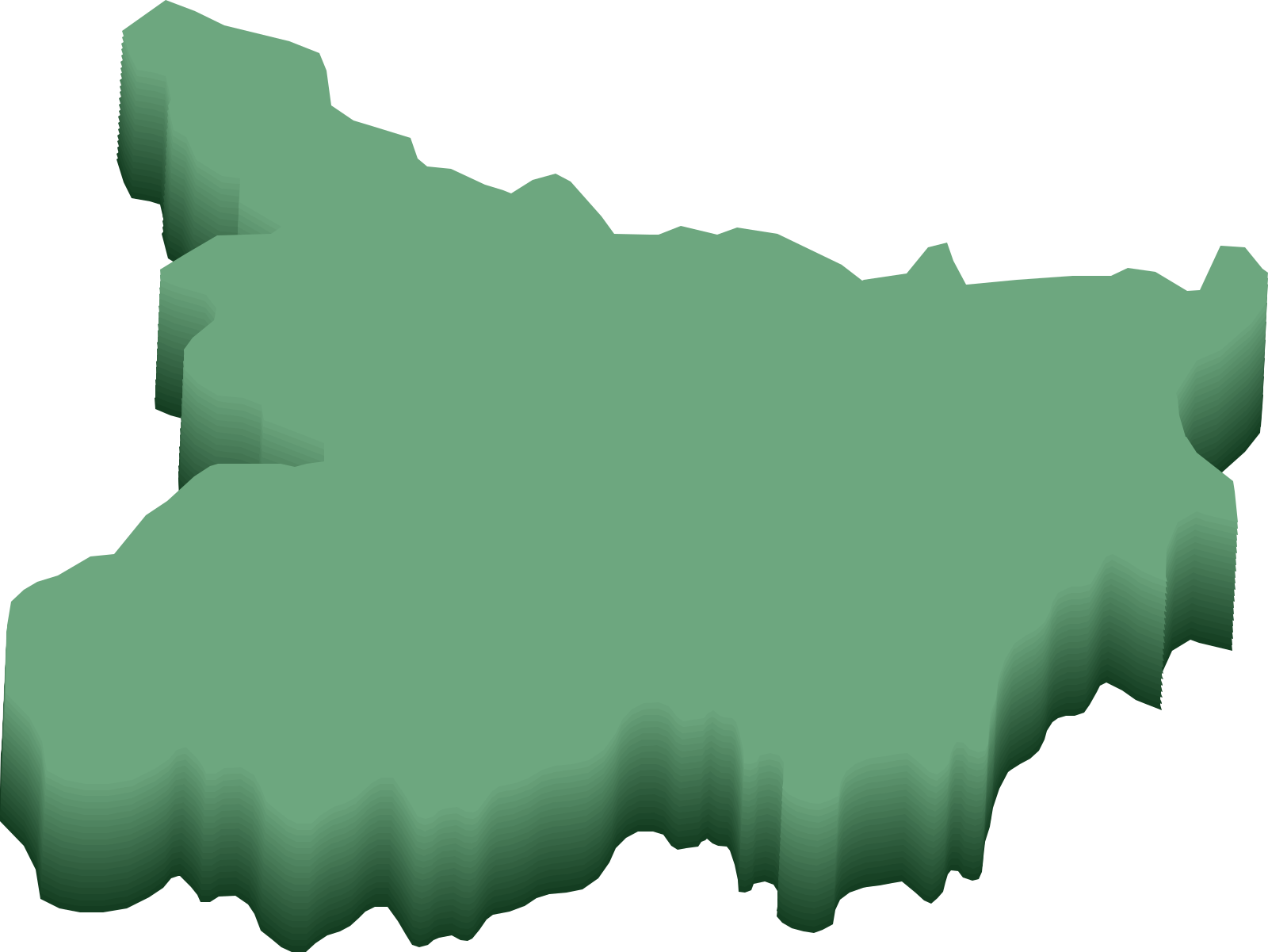
About Sheohar District (Bihar)
Sheohar district, a part of Tirhut Division is a district of Bihar state with its administrative head quarters located at Sheohar town. It is one of the most flood prone districts in Bihar. Mostly during the monsoon season the increasing water level of the Bagmati and Budhi Gandak Rivers creates the problem of flood in this area. Earlier, it was a part of Sitamarhi district but it was carved out in the year 1994 and in the same year it was emerged as a separate district in the map of Bihar state.
Geographically, the district lies at 26°51'N latitude, 85°29'E longitude and 53 m Altitude. In the year 2023, there was a total 8.72% forest area of total geographical area. The district encompasses a geographical area of 349 sq. kms. and it is bounded by East Champaran district on the North West and West, Sitamarhi district on the North East and East and Muzaffarpur district on the South. The climate of the district remains extremely hot during the summers. Most of its rainfall occurs in the monsoon season. The actual rainfall in the district was 802.7 mm in the year of 2024-2025.
Administration wise, the district has only one sub-division namely Sheohar, which is further, divided into five developmental blocks including Sheohar, Tariyani, Piprahi, Dumri-katsari and Purnahiya. There are 1 Lok Sabha seat and 6 Assembly constituencies. Moreover, the district comprises 1 town and 203 villages. The administrative language in the district is Hindi.
According to 2011 census the district has a population of 6,56,246 out of which 3,46,673 are males and 3,09,573 are females. The district has a sex ratio of 937 females for every 1000 males. Furthermore, the district has projected population of 8,00,285 comprising 4,23,316 males and 3,76,969 females for the year 2026. According to the National Family Health Survey (NFHS-5, 2019–21), the district has an estimated sex ratio of 1,066 females and a child sex ratio of 914 females per 1,000 males. During the year 2001-2011 the population growth rate in the district was 27.19% including 26.67% were males and 27.77% were females. As per 2011 census the major religions in the district are Hindu and Muslim with 84.19% and 15.14% of the total population. The population density in the district is 1,880 persons per sq. kms. According to 2011 census the principal language in the district is Hindi with 91.89%. In the year 2023 the number of live births in the district was 23,919 out of which 13,033 were males and 10,886 were females. In the same year the number of deaths in the district was 1,988 out of which 1,196 were males and 792 were females.
Agriculture is the backbone of the economy of the district. Some of its chief agricultural products are rice, wheat, and a number of rabbi crops. Almost all population in the district are engaged in agriculture since it is scantily industrialized. Only a few agro based industries are found in it which also helps in its economy to some extent. In 2006 the ministry of Panchayati Raj declared Sheohar as one of the country's 250 most backward districts and currently receiving funds from the Backward Regions Grant Fund Programme (BRGF). In the year 2023-2024 the Gross Domestic Product in the district was Rs. 3,13,090 lakh at current price and Rs. 1,80,628 lakh at constant 2011-2012 prices. The Net Domestic Product in the district during the period 2023-2024 was Rs. 2,81,882 lakh at current price and Rs. 1,59,604 lakh at constant 2011-2012 prices. The Per Capita Income or NDDP, At Factor Cost in the district during the period 2023-2024 was Rs. 34,405 at current price and Rs. 19,481 at constant 2011-2012 prices.
Sheohar district has numerous primary level schools but there is a lack of secondary level and the higher level educational institutions which compels its students to go to some other place in order to take higher education. As per 2011 census the literacy rate in the district 53.78% including 61.31% are males and 45.26% are females. The number of literates in the district is 2,83,698 out of which 1,71,645 are males and 1,12,053 are females. In addition, according to the Periodic Labour Force Survey (PLFS) for the period July 2023-June 2024 estimated literacy rate in the district is 60.06% including 67.27% are males and 50.79% are females (Age 7 Years and Above).
Thakur Jugal Kishore Sinha, an eminet Indian politician and a member of the 1st Lok Sabha from Muzaffarpur North-West constituency was born in 1908 in the district. He was a vital part of the freedom movement and also known as the Father of cooperative movement in Bihar.
The best time to visit the district is in between October and March since at that time the weather is conducive for sightseeing. The ancient temple of Lord Shiva at Dhancoul or Dekuli is a popular place of pilgrimage for devotees. The Bagmati and Budhi Gandhak rivers offer scenic sightseeing opportunities on either bank as well as a chance for boating on certain stretches. It has several other centres of attraction which helps one to connect with nature and rejuvenate himself.